HELLO AND WELCOME TO FLASH BRAND PORTFOLIO Flash is a Web-based business offering imported equipment for digital photography and video. Branding is a focused program that is designed to strategically promote a group or brand by creating a brand, brand name, brand identity, package design, environmental design, website, apps, promotional design, and advertising (Landa, 2011). The goal of Flash's brand is to target professionals and pro-consumers in digital photography and/or video by providing high-end imported equipment. The challenge of promoting Flash's brand is that Flash is a web-based business with no physical store, thus the challenge to create a unique brand for Flash that will stand out from competitors. I have created Visual Board Identity, Logo, Ads, Collateral Design, and a Website to promote Flash's brand. You can scroll down to next section or click a link on the header above.
Visual Identity Board
Flash brand visual identity
The goal of the visual identity is to give visual and verbal articulation of a brand or group with the design applications and the keystone of visual identity is a logo (Landa, 2011). I have designed my visual identity board to include pattern/texture, colors, typography, logo, and additional materials for Flash's brand.
Reasoning
Color is a powerful and highly provocative design element (Landa, 2011). Color in any design is very important and should be selected very carefully with the target market in mind. Since my target market is professional and pro-consumer, I wanted color selections to be elegant, universal yet unique. Also, color has a language all its own, where to some individuals colors can carry symbolic, cultural, and psychological meaning (Evans & Thomas, 2008). For instance, the color blue is often used extensively in business where it conveys a sense of reliability and trust to consumers, while the color red carries a feeling of festivity and is typically associated with imagination (Evans & Thomas, 2008). As Flash is in the photography and video business, I feel it is important for Flash to convey the feeling of reliability but at the same time boost the imagination. For that reason, I have choose a tone color of blue and red in Flash's color palette. I choose white and charcoal colors for the high contrast value as in photography business, the ability to see products or images is very important. In addition, white and black offer a high degree of contrast and are the choice for many publications and/or signs (Evans & Thomas, 2008). Lastly, I want to have a neutral color to bring out some of the images and since gray is a universal neutral color, I choose a tone of gray as one of the colors in my palette. Typography is the design of letterforms and usage of them in print and screen-based text, and motion and interactive media (Landa, 2011). There are literally thousands of different typography and with each of them comes its own meaning and use for different purposes. When I was exploring options for the typography choices, I wanted the typography to have readability and display the aesthetics sense of an on-line camera and/or video market. Using the guide from Graphic Design Solutions by Robin Landa (2011) visual interest, appropriateness, clarity, and relationship are used to select the typography. With the guide, I have selected Marvel and Rationale as Flash's main typography. I feel that Marvel and Rationale font combined work very well together and carry the feeling of a web-based business in the field of camera and/or video. I wanted textures and patterns to represent Flash as a business in digital technology. With that in mind, I choose gradient which is commonly used in the photography field. Another item in the usage of creative photography idea is paper texture as a texture which I have done with rustic metallic and vintage paper textures. At the same time, I want Flash to be in with the latest trends of technology, so I used the pattern that can be found inside the camera's parts which can carry some volume to certain sections. Usage of texture will provide opportunity to create variety and depth in the design and helps to stand out figures when designs are layered (Evans & Thomas, 2008). I needed to pull some images and symbols that are often found in the digital technology field to help develop a brand for Flash. Thus, I pulled up images of an external flash, the symbol for camera, various parts of lighting equipment, and a camcorder. With those images, I can help to bring cohesive identity allowing Flash to be recognized as a business in digital technology.
Flash Logos Logos are a unique identifying symbol that represents the brand of the company (Linda, 2008). The logo needed to be memorable, recognizable, unique, and have scalability (Linda, 2008). With that guide in mind, I have designed 3 different logos with different color combinations to fit in almost every situation. Logo
The logo above is a lettermark logo where the focus of the logo is an initial of the brand name (Landa, 2011). In this logo design, I wanted to strike the right balance of measure for the letter 'F' with its slope and length/width on each line. This logo represents best for business and pro-consumer where the design heavily depends on simplicity yet is recognizable and memorable. Also, I wanted to have strong contrast on the letter 'F' and its background, so I selected primarily white and black colors. The additional colors are for when the design calls for different colors. In my design, I use the linear concept, where lines are used as the main element to show shape (Landa, 2011). In this case, I used lines to create the letter 'F' in the enclosed square. This is also the primary choice for Flash's logo.
The logo above is a combination mark that words and symbols are used together in the logo (Landa, 2011). I heavily used the linear design in this logo category to represent the frame of camera and flash symbol. In addition, I used the negative spaces to create a dramatic pause (Landa, 2011). The logo uses a flash symbol with a custom stroke along with line to border the unit. The word "Flash" is inserted on the slope of the flash symbol to promote brand. The logo above is emblem logo, where a combination of words and visuals will be always together, never separated (Landa, 2011). The logo uses the flash symbol but with a twist on the stroke and represents the L in logotype of FLASH. I feel this logo is whimsical yet is a professional image at the same time which is represented well in the professional or pro-consumer market.
Advertising
Flash Advertising Advertising is often used to promote a specific brand over another. In addition, it is a specific message designed specifically to inform, persuade, promote, provoke, or motivate people based on the brand (Linda, 2011). Since Flash is an on-line based business, Flash relies heavily on advertising to promote the brand and to sell products to consumers. I wanted to have both functional and emotional benefit ad types, so I designed three different ads.
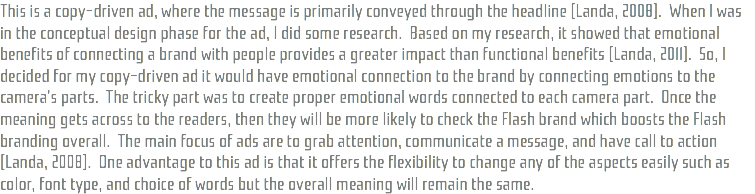
This is a copy-driven ad, where the message is primarily conveyed through the headline (Landa, 2008). When I was in the conceptual design phase for the ad, I did some research. Based on my research, it showed that emotional benefits of connecting a brand with people provides a greater impact than functional benefits (Landa, 2011). So, I decided for my copy-driven ad it would have emotional connection to the brand by connecting emotions to the camera's parts. The tricky part was to create proper emotional words connected to each camera part. Once the meaning gets across to the readers, then they will be more likely to check the Flash brand which boosts the Flash branding overall. The main focus of ads are to grab attention, communicate a message, and have call to action (Landa, 2008). One advantage to this ad is that it offers the flexibility to change any of the aspects easily such as color, font type, and choice of words but the overall meaning will remain the same.
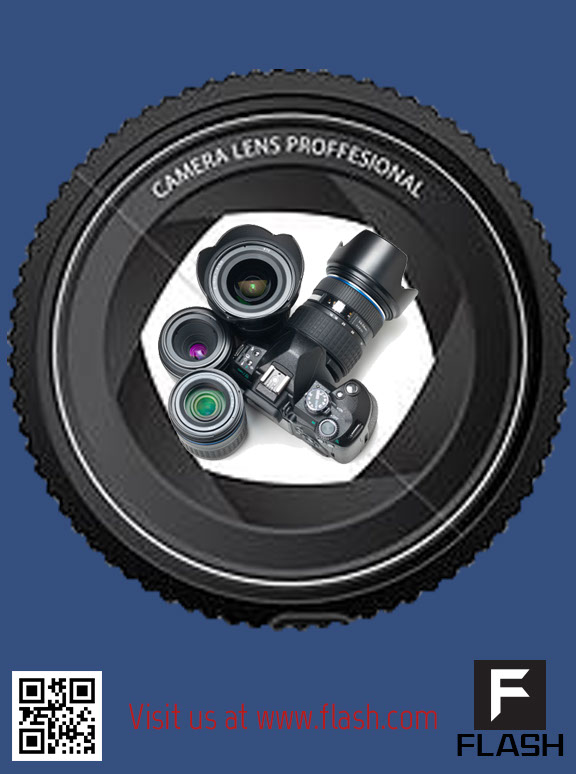
This is a visually driven ad, where the ad communicates primarily by visual means (Landa, 2011). Flash is a business in the field of photography, so I wanted to create a unique visual of a camera shutter and then display variety of gears within the shutter area. I selected the design to create a design that will grab the reader's attention and to take a second look at the ad to achieve the means of advertising (Landa, 2011). Which is known as visual surprise to make viewers take a second take on the ad (Landa, 2011). In addition, I wanted to make good use of QR code due to Flash's on-line business presence and reaching target markets of professional and pro-consumers who typically have their smart-phone with them.
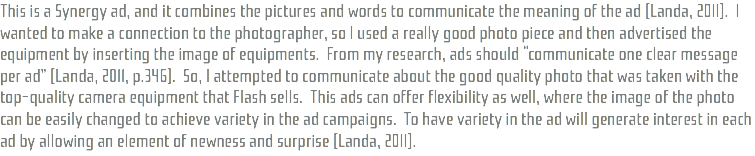
This is a Synergy ad, and it combines the pictures and words to communicate the meaning of the ad (Landa, 2011). I wanted to make a connection to the photographer, so I used a really good photo piece and then advertised the equipment by inserting the image of equipments. From my research, ads should “communicate one clear message per ad” (Landa, 2011, p.346). So, I attempted to communicate about the good quality photo that was taken with the top-quality camera equipment that Flash sells. This ads can offer flexibility as well, where the image of the photo can be easily changed to achieve variety in the ad campaigns. To have variety in the ad will generate interest in each ad by allowing an element of newness and surprise (Landa, 2011).
Collateral
Collateral design is a great way to promote brands by using different materials and design that focuses on marketing specifically to the market audience. The examples of collateral design includes flyers, brochures, annual reports, trade show booths, web banners, and much more (Collateral Design, n.d.). For Flash's brand effort, I decided to select three of the best collateral designs that I come up with, which are a billboard, gift card, and USB drive.
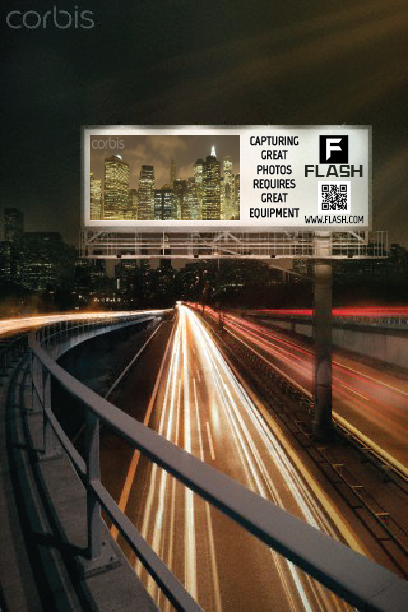
With the billboard, I decided to go with the suggestion that the professor made with the image being carved out of the billboard and display the ‘cool look’ of the city itself showing how equipment can capture such a great picture. Billboards are one good way for Flash to advertise with QR code. For the statement on the billboard, I went with functional benefits statement to focus on what Flash product can bring to customers (Landa, 2011). Additionaly, the unique design will make customers really have to pay attention to the advertising since it is not just another billboard but one that really grabs their attention. During creative mode, I based my ideas around those guides using visual surprise, merging things, and being literal and really pushing it (Landa, 2011).

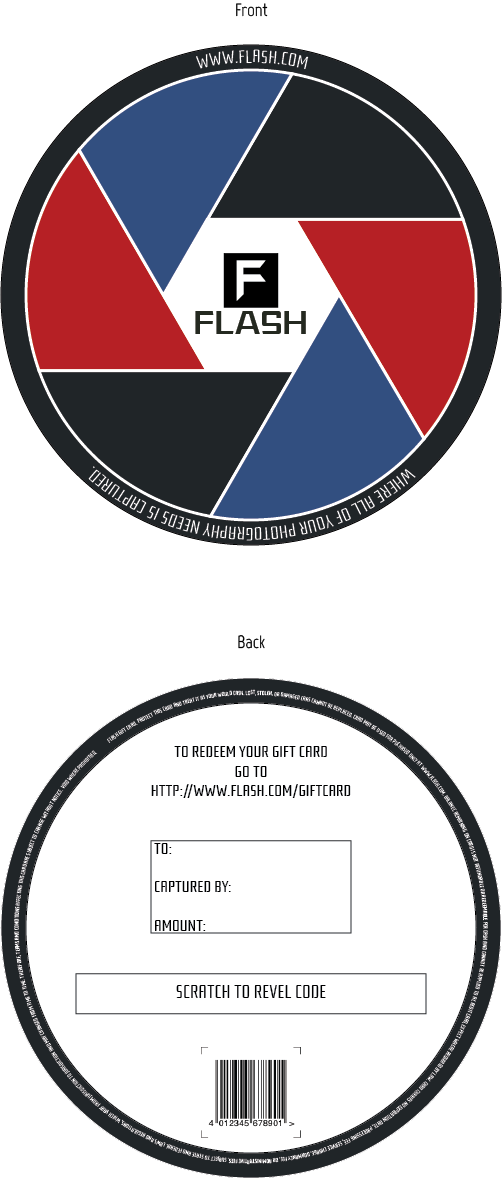
According to the studies, it shows that 85 percent of the US population will exchange gift cards and sales of gift cards will surpass $110 billion (Press Releases, 2012). This is a huge asset for Flash to be a part of and being an on-line based business, a gift card is one of the better ways to promote their branding. I wanted to break the mold of the typcial square gift card, so I spendt time using the creative thinking method. I used the mapping method, where it is a visual representation, diagram, or presentation of the various ways that design relates to each other (Landa, 2011). It was during my mapping that I came up with this geometric shape, a circle, and shutter design which is unique, yet recognizable for a customer in the photography field.
Flash is an on-line based business, and the primary target is to business and pro-consumers who are into the digital photography and videoing arena. Which means all target customers should have access to a computer, and I thought a USB drive would be the perfect tool for branding efforts with the ability to load promotional pieces onto the drive and be more environmentally friendly. Also, customers will be more receptive to the brand if the business is able to keep up with the customer’s need and evolve along the way in technology and culture, which the USB drive creates a positive link between usefulness flash and brand (Beissel, 2010). As branding is reflected better with the image of the camera as the USB Drive. In addition, a USB drive is one of positive driven for branding and shows that the company is driven to bring the latest technology to the customer’s hand. My vision for Flash with the USB drive is to use it as a manual, brochure, and many other digital goods for customers. It will also reflect well for the company as it attempts to be more environmentally friendly by using the USB drive instead of papers. I wanted a design that would grab one's attention rather than a generic flash drive. The purpose of promoting the brand is to make it easy to recall and create something memorable for customers (Landa, 2011).
Flash Collateral Design
Website
Flash Website Flash is an on-line based business, which mean a website will be Flash's major project and their largest branding effort will lie within the website. A website is one way to interact with customers allowing for an engaging interactive experience for users (Landa, 2011). The important points for web design is to respect the user, engage users using visual interest and clarity, merge the design of website with brand identity, good logic web hierarchy, content should be easy to find, read and print or download, offer media-rich experience, provide interactive environment where it promotes relationship between user and brand, and follow ADA guidelines (Landa, 2011). With the guidelines outlined above, I designed Flash's website with that in mind, where all of Flash website will be dynamic and interactive in every aspect and at the same time accessible to everyone.
This is Flash's homepage, it is a dynamic page where pictures will actually rotate on the circle. When the user hovers their mouse on any of the pictures words will appear on the middle of the circle. Then when the user clicks one of the pictures on the circle, the pop up will appear with categories for users to select to go to a specific product page. Also, all of the pages will be responsive in the design since mobile phones are becoming more popular way to display content and message (Landa, 2011). In addition, I want the website to be rich in interactive and actual engaging viewers to enjoy the website. Having a rich user experience will improve website value and draw visitors into the page and retain them (Landa, 2011).
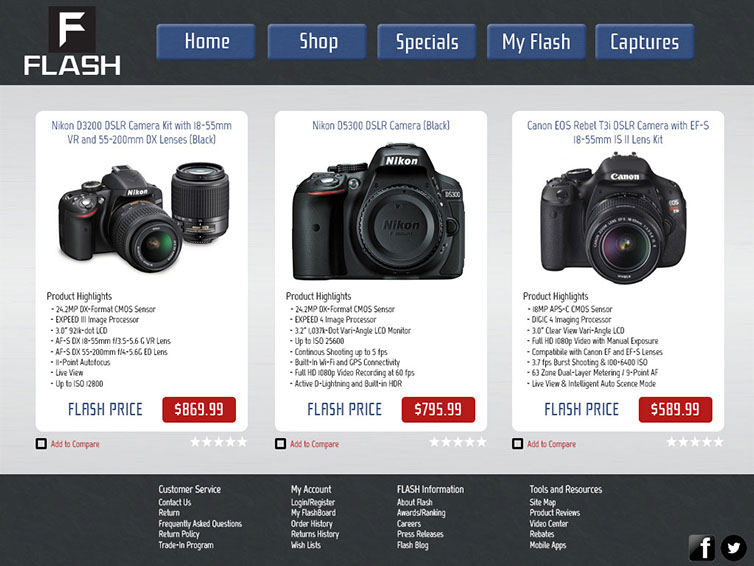
This is a product page with product pictures along with highlights of products. Below the product pane, it has a check mark box to select to add it to the compare list. It will also have star ratings from various users and they can leave reviews on the products to provide a more interactive experience. Brand images and visualization through out the website should be consistent across all media to sustain a brand (Landa, 2011). I want users to feel that they are on the same website as they browse through Flash's website, so the header and footer will be consistent all through out Flash's website. Also, having the option to navigate in the header and footer will enable users to navigate anywhere on the website from any web page, which is an important aspect of web design (Landa, 2011).
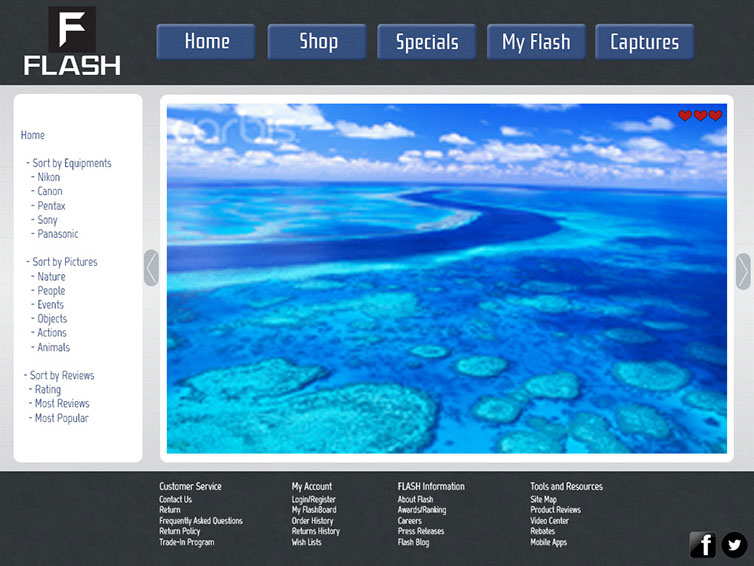
This is a creative page for Flash, where users can post their "Captures" on Flash's website and I want the pictures to be prominent on this page to display images from users. Hearts on the top left and arrows on the sides of each picture is actually dynamic and won't appear until a user hovers near them. When the user clicks on the picture, it will take them to a new page with equipment used to take the picture and name capturer with their notes and information. The goal of the creative page is to create an engaging and interactive interface for customers to take a part of and build a relationship with the brand (Landa, 2011).
References
Allofs, T. (n.d.). Australia's Great Barrier Reef [Stock Image]. Retrieved December 1, 2013, from http://www.corbisimages.com/stock-photo/rights-managed/AACD0563/australias-great-barrier-reef?popup=1 Becar, M. (n.d.). Flash [Stock Image]. Retrieved November 3, 2013, from http://www.gettyimages.com/detail/photo/flash-royalty-free-image/104018942 Beissel, J. (2010, September 28). Marketing Must: Why You Need Promotional USB Flash Drives [Web log post]. In Premium USB Blog. Retrieved November 9, 2013, from http://blog.premiumusb.com/2010/09/why-marketing-need-promotional-usb-flash-drives/ Canon EOS Rebel T3i [Photography]. (n.d.). In B&H Photo Video. Retrieved December 1, 2013, from http://www.bhphotovideo.com/c/product/753762-REG/Canon_5169B003_EOS_Rebel_T3i_Digital.html City billboard. [Stock Image]. (n.d.). In Corbis Images. Retrieved November 17, 2013, from http://www.corbisimages.com/images/Corbis-42-41658335.jpg?size=67&uid=dd756157-a055-44cf-a367-f2a65689aba1 Collateral Design. (n.d.) In Westway Studio. Retrieved December 20, 2013, from http://www.westwaystudio.com/design_collateral.html Collins, C. (n.d.). High definition video camera [Stock Image]. In Corbis Images. Retrieved December 16, 2013, from http://www.corbisimages.com/stock-photo/rights-managed/42-22999012/high-definition-video-camera?popup=1 Cordoza, T. (n.d.). Digital Camera [Stock Image]. Retrieved Novemember 3, 2013, from http://www.gettyimages.com/detail/photo/digital-camera-royalty-free-image/146182541 Cruz, J. (n.d.). Lighting equipments in photographer's studio [Stock Image]. Retrieved December 1, 2013, from http://www.corbisimages.com/stock-photo/royalty-free/42-35809255/lighting-equipments-in-photographers-studio?popup=1 Evans, T. & Thomas, M. (2008). Exploring: The Elements of Design (2nd ed.). Clifton Park, NY: Delmar Cengage Learning.

Landa, R. (2011). Graphic Design: Solutions (4th ed.). Boston, MA: Wadsworth. Manning, L. (n.d.). Memory Cards [Stock Image]. Retrieved December 1, 2013, from http://www.corbisimages.com/stock-photo/royalty-free/CB054738/memory-cards?popup=1 Mnich, M. (n.d.). Digital camera [Stock Image]. Retrieved November 3, 2013, from http://www.gettyimages.com/detail/photo/digital-camera-royalty-free-image/182891784 Muller, P. (n.d.). Portrait of American football player resting foot on ball [Stock Image]. In Corbis Image. Retrieved December 19, 2013, from http://www.corbisimages.com/stock-photo/rights-managed/42-52318295/portrait-of-american-football-player-resting-foot?popup=1 Nikon D3200 [Photography]. (n.d.). In B&H Photo Video. Retrieved December 1, 2013, from http://www.bhphotovideo.com/c/product/1010451-REG/nikon_13309_d3200_dslr_camera_kit.html Nikon D5300 [Photography]. (n.d.). In B&H Photo Video. Retrieved December 1, 2013, from http://www.bhphotovideo.com/c/product/1010022-REG/nikon_1519_d5300_dslr_camera_black.html O’Rear, C. (n.d.) Photographer’s Cameras and Equipment [Stock Image]. In Corbis Images. Retrieved December 16, 2013, from http://www.corbisimages.com/stock-photo/rights-managed/OR006027/photographers-cameras-and-equipment?popup=1 Press Releases. (2012). In CEB. Retrieved November 9, 2013, from http://news.executiveboard.com/2012-12-17-Gift-Card-Sales-To-Top-110-Billion-As-Card-Spillage-Declines-20-Percent Spielman, J. (n.d.). Lower Manhattan skyline at night, New York City, New York, USA. [Stock Image]. In corbie images. Retrieved November 17, 2013, from http://www.corbisimages.com/images/Corbis-42-27340229.jpg?size=67&uid=35880a30-fe64-4313-80f3-7641ddb7efb9 Vector illustration of camera lens on white [Stock Image]. (2010). Retrieved November 3, 2013, from http://www.canstockphoto.com/vector-illustration-of-camera-lens-5077380.html Vogel, B. (n.d.) Lonely model in photostudio [Stock Image]. In Corbis Images. Retrieved December 16, 2013, from http://www.corbisimages.com/stock-photo/rights-managed/42-31576542/lonely-model-in-photostudio-?popup=1

Designed by Daniel Lute for GRPH310 @ Franklin University

Daniel Lute @ djlute.com

Copyright 2013. All Rights Reserved